Sustainable Development Goals, Mental Health and Wellbeing
In September 2015, mental health was formally included in the United Nations Sustainable Development Goals (SDGs). This marked a historic shift in how development is understood and measured.
Within this framework, two ideas are particularly relevant to how mental health is understood today: a new definition of progress, and the principle of “Leave No One Behind.”
A new definition of progress.
The SDGs reject a purely economic definition of progress. Economic growth alone does not guarantee wellbeing. A society can expand financially while large segments of its population experience anxiety, exclusion, chronic stress, addictions and other mental health challenges.
Instead, the SDGs reflect a broader understanding of development. Progress has to be measured by wellbeing, resilience, and the capacity of individuals to live meaningful lives. This includes the ability to form relationships, recover from adversity, participate in society, and imagine a future.From this perspective, mental health is both an outcome of development and a condition for it. Without mental wellbeing, advances in other areas remain fragile and vulnerable to collapse.
The principle of Leave No One Behind
This commitment recognises that development cannot be considered successful if its benefits are unfairly distributed or if entire groups remain excluded.
Applied to mental health, this principle exposes deep inequalities.
Access to mental health support is shaped by income, geography, gender, migration status, legal protection, and social exclusion. Those most exposed to stress, trauma, and instability are often the least able to access care, support, or safe environments.
Mental health becomes a justice issue when individuals are expected to cope heroically within systems that are structurally unequal.
The framework provided by the SDGs challenges this logic by shifting attention away from individual resilience toward the conditions that make wellbeing possible in the first place: equality, access, inclusion.Leaving no one behind means recognising mental health as a shared responsibility, that requires inclusive policies, accessible services, protective environments, and social systems designed to uphold human dignity.
A global priority
The inclusion of mental health in the SDGs marks a decisive change. Mental health is no longer a private or secondary concern, but as a foundational condition for human wellbeing, social participation, and sustainable progress, and a global development priority for the following fifteen years.
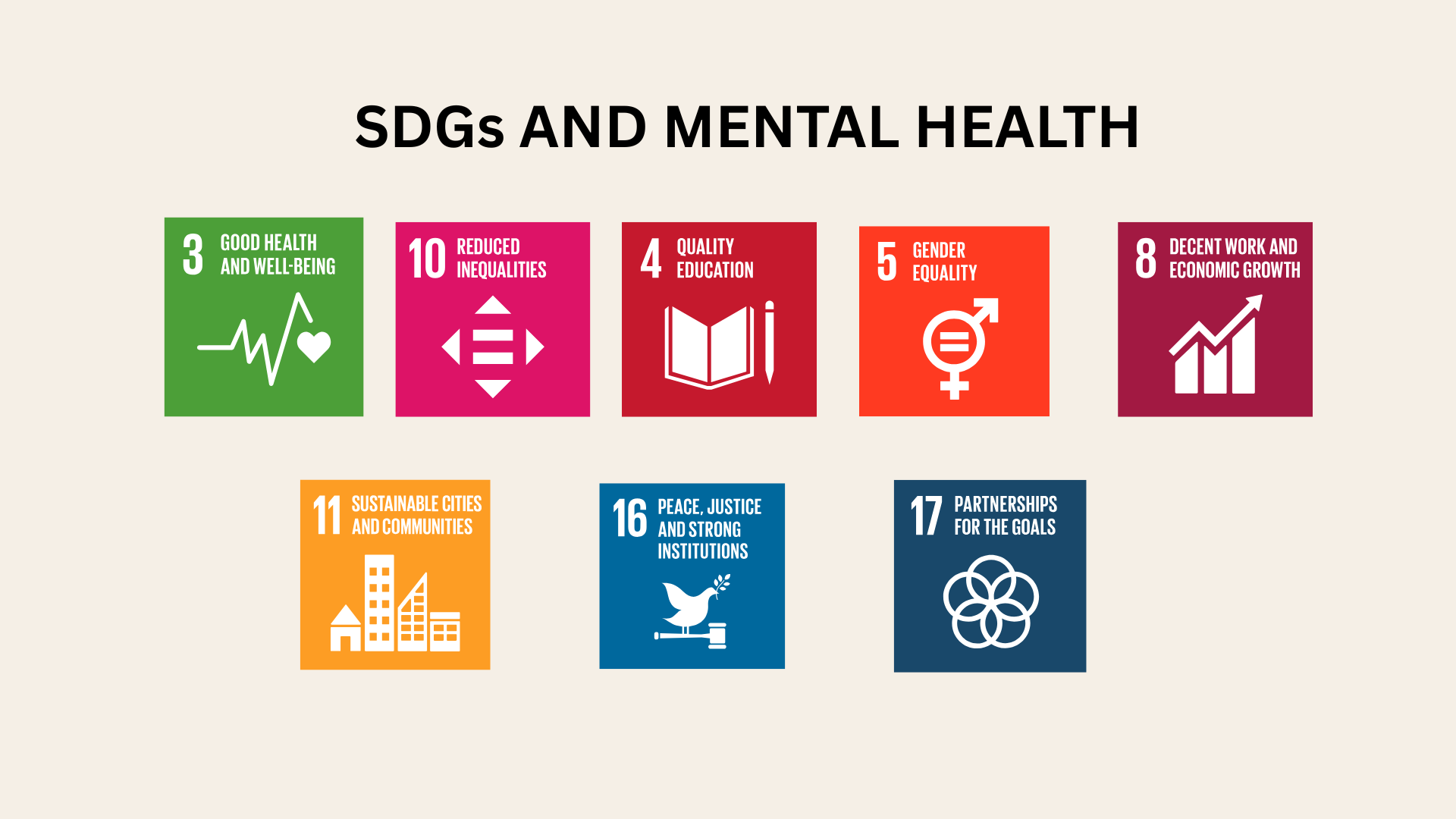
UN Sustainable Development Goals